
For years, I believed that staying in motion was how I kept myself safe.
I lay awake in bed most nights, replaying and rehearsing hard and unpleasant conversations in my head, cataloguing my points and chastising myself when I forget them. I wonder, Did the person I argued with understand why I was upset? Could I convince them that I was right? The late-night conversations progress much like the writing of this essay–me talking to the blank apartment walls, choosing and changing words faster than they could be absorbed into my brain and converted into words on paper, constructing the responses that I wanted to hear, and not the ones that I heard. Some nights I could forestall the one-sided conversations by making decisions, quickly—book a flight, schedule a tour, buy something—done.
Quick decision-making is movement. The decisions fill the space where the internal dialogue lives. Book a trip instead of sitting with the email that carries bad news. The confirmation appears on the screen. The email goes quiet.
So that’s how I came to be riding a motorbike across West Africa—through a random Facebook post and a late-night search for a flight. The trip details: eight days and three countries with more potholes than a highway after winter. And even though I had never driven a motorbike before, I mentally ticked off the reasons it was okay: I could ride a bike and I had taught my kids how to drive.
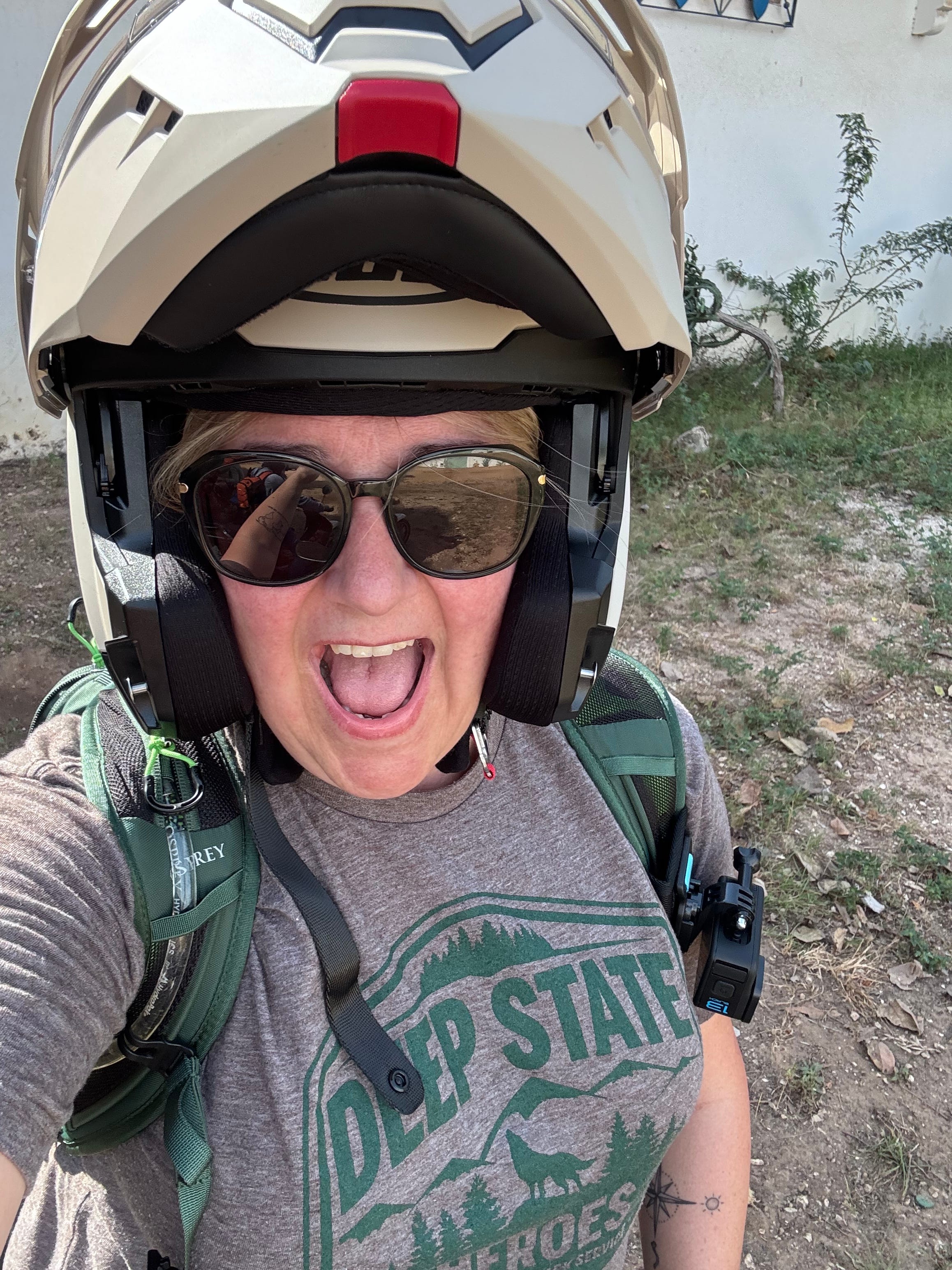
The first morning on the motorbike, I struggled with the mechanics of riding. The engine revved, the bike jerked but I puttered along building confidence as the miles of grassland passed us by. Later that morning, our group of ten came upon a small village, the road filled with people, carts, and animals. Riding at the back of the group, I mimicked the riders in front of me, noticing as they dropped their foot to the ground as they turned right. But my bike didn’t slow down like theirs had, and soon I found myself on the heels of the rider in front of me. I furiously started stomping the back brake, but the bike started sliding in the opposite direction that I wanted to go. The next thing I knew, as I missed the turn, I was looking right into the eyes of an old man pushing a cart full of produce.
After getting back on the road, I caught up to the group and began pushing the bike to 40 miles per hour. I allowed my mind to wander as the warm breeze cooled my sunburned arms. I stole glances at the passing countryside, taking in the women carrying children on their backs and baskets on their heads.
The riding was going well, that is until we came to a left-hand turn. What happened next unfolded slowly in front of my eyes, even as the bike continued to speed towards the next intersection. Realizing I wasn’t slowing down quickly enough, I looked to my right to see if I could safely make the turn. That’s when I saw it. A white van coming straight at me. I quickly looked to my left, and seeing an empty lane, I pulled the handlebars left. In my mind, I was jerking the bike all over the road, and panic started to settle in. As I moved back into the right lane, my hands turned up the accelerator, as I tried to create space between my bike and the white van.
This time there was no swearing. I was simply praying to God to bring me safely home to the kids. Even though I had gotten the bike up to 40 miles per hour, this time, shaken to my core, I couldn’t go more than 30. I could feel my hands shaking on the handlebars, gripping it so tight that the sweat pooled in my palms. For the first time, I asked myself, what are you doing? I would never ride a motorcycle at home. Why did I think it was acceptable to ride one here?
Our tour leader realized I was struggling. He kept asking if I was comfortable driving. At that moment, I kept worrying about what they would do with the extra bike. I knew I would have to make a decision. I delayed saying yes to him because I kept thinking it would click and my feet would remember the brakes. The coordination of driving a car would translate to the motorbike. By mid-afternoon, as we were ready for a fuel stop, we arrived at a very busy city. The streets were packed with bikes and people and dogs running loose. With all the activity, I couldn’t see where the group had gone. I only knew to pull to the curb. By the time I clumsily slowed the bike, the tour leader was at my side, taking over for me. As I walked to the group, I heard myself ask the tour leader, “Can you find someone to drive the bike?”
As the trip progressed, I couldn’t help but wish I was driving the bike through the sand and water. But every time I thought about it, my heart would start racing and my palms would become sweaty, as if my body was telling me, it was time to quit.
Later, recounting my story to my brother, I thought about my unfinished will. One that in the wake of another’s recent passing, I had promised to finish before leaving. Quitting to stay alive seemed like a good trade-off.