When Home Stops Being a Place
On bare walls, borrowed spaces, and the unexpected ways home reshapes itself

After a week of winding my way from DC to Oxford to Chicago and then flying back east again, I’ve had hours of quiet in cars and airports—the kind of hours that make you sit with the questions you’ve been avoiding. One of them: What is Home?
Last week, we checked into the Airbnb I rented in the Chicago suburbs. Nothing was remarkable about the place—just a clean rental with neutral walls and a couch that has certainly hosted many families before ours. And yet, as I walked from room to room, I felt an unexpected ache rise up in me. Not sadness, exactly—something more like recognition. A quiet reminder of how much has changed in one year.
Since this time last December, I changed jobs, sold my house, and moved east to Washington, DC. I traveled through Cambodia and Laos, celebrated Tet with Minh and her family, wandered the streets of Paris and the castle ruins of Wales. I wrote a book. I began the next one. And somewhere in the middle of all of that movement, I started imagining where I might go from here.
I wouldn’t trade any of it—the job, the move, the passports filling up with stamps, the late-night notes that turned into chapters. But change, even the kind we choose, has a way of brushing up against the more fragile parts of us.
And nothing made that clearer than standing in a holiday season without the very things that once defined it for me.
For nearly two decades, Christmas meant unpacking the same boxes: the tree ornaments I collected one by one, the snow globes and school treasures the kids brought home, the embroidered towels we never actually used, the reindeers and lighted trees for the yard that made our house glow during the long Midwest nights. These rhythms were anchors—small rituals that said, You live here. This is your home. You belong here.
But this year, our Airbnb is devoid of any memories. The walls are bare. The fridge holds nothing but frozen meals and coffee creamer. The trash fills quickly with takeout containers. It is a place to stay, not a place that knows us.
And in that absence, I felt a flicker of fear:
What if I’m losing my sense of home altogether?
Is home a physical structure—the address we return to each night?
Is it the place filled with our belongings, where we drop our bags and finally exhale?
Is it where our children are, or where they return to us?
Or is home something far less visible—a memory map we carry inside, shaped by every room, every person, every season that has ever held us?
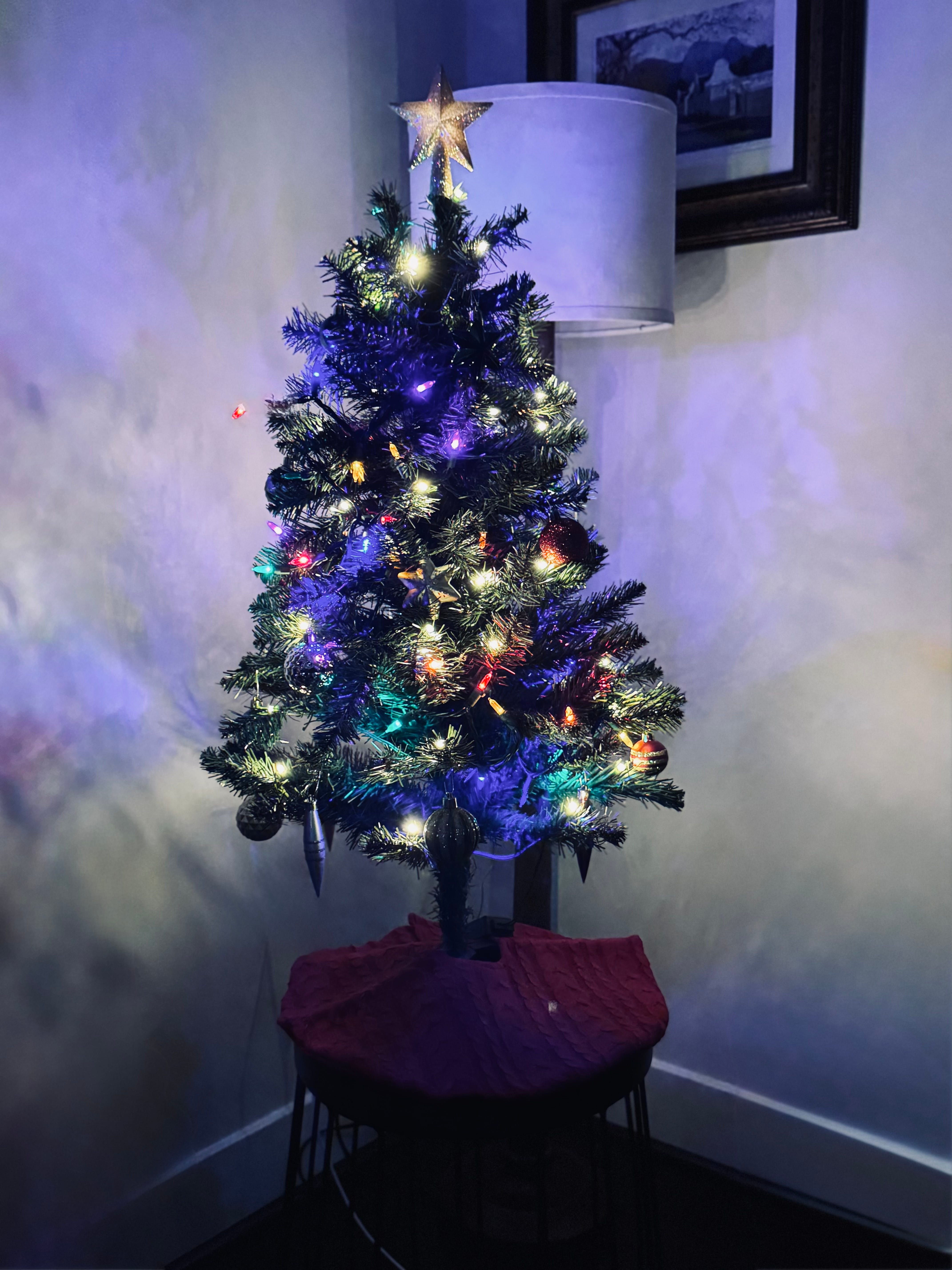
These questions followed me all the way from Chicago back to DC, where a tiny tabletop Christmas tree (purchased on a whim from Target) now sits in the corner of my apartment. It’s the smallest tree I’ve ever owned, barely two feet tall, nothing more than a strand of lights wrapped around a miniature frame with a few generic ornaments hanging from it.
And yet, in the quiet of the evening, when the lights reflect softly on the wall, I feel something familiar. Not the old definition of home—the one rooted in stability and sameness—but a new one, made of movement and reinvention and the willingness to let life shift without losing myself in the process.
Maybe home isn’t where we settle.
Maybe home is what evolves with us.
Maybe it’s the part of ourselves that stays steady when everything else changes.
I’m not sure I’ll ever arrive at a final answer. But for now, I’m learning to see home not as a fixed point, but as something inside me—one that continues to adapt, reshape, and travel wherever I go next.
Tracy, this is so quietly powerful. That line about the Airbnb being “a place to stay, not a place that knows us” landed right in the chest. I recognize that ache — not grief exactly, but the moment when chosen change taps on an older rhythm and asks to be acknowledged.
What I appreciate most is how you don’t rush to resolve it. You let home be unsettled, evolving, provisional. That tiny Target tree feels like the perfect symbol — not a replacement for what was, but a marker saying, I’m still here, even as the shape shifts.
I keep coming back to your question about whether home is something we carry. I suspect it is — a kind of internal furniture that gets rearranged rather than discarded. Less rooted, maybe, but more resilient.
Thank you for naming this so honestly. It’s a relief to read someone articulate the in-between without trying to make it tidy.
– Kelly
I so appreciate this Tracy and can relate in so many ways. I decided to live in two continents a couple of years ago, and sold the place I called home. Two years later, I still feel somewhat "home-less" every now and again. I like what you're suggesting though... about home being something inside me instead of an external place... I'm going to sit with that for a while. I'm glad I stumbled on this... Cheers!